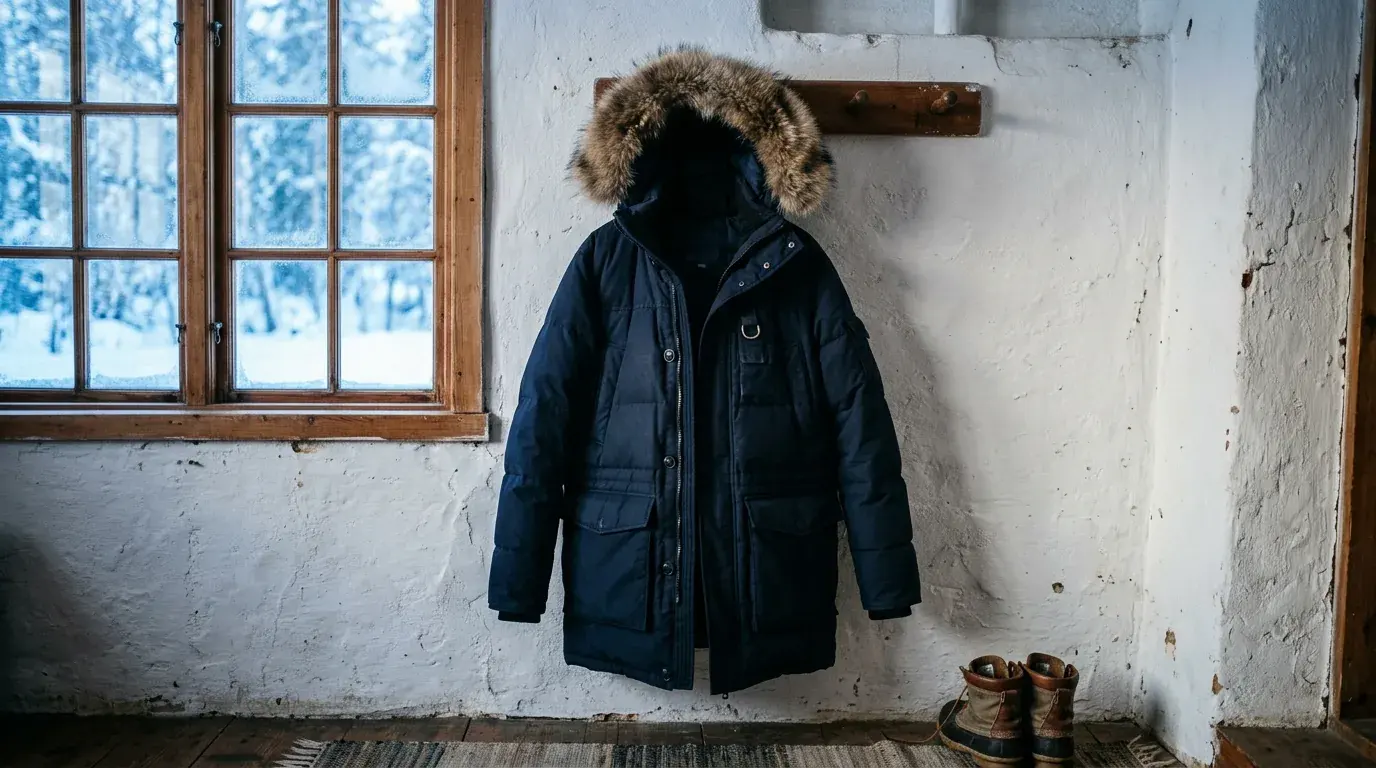
Nobis makes the kind of coat that earns its price in a Nordic winter rather than a city catwalk. Built in Canada, the range pairs serious insulation and weatherproofing with a cut clean enough to wear to dinner — technical luxury rather than logo luxury.
The performance credentials are real: high fill-power down or advanced synthetics, sealed seams, storm cuffs and hoods designed for actual wind and snow. For anyone north of the mild zones, that is the difference between a coat that looks the part and one that does the job.
What makes it relevant to a quiet-luxury wardrobe is restraint. The styling is understated, the materials do the talking, and the construction is built to last seasons rather than one fashion cycle — the same philosophy we apply to leather bags and watches across this site.
It is an investment piece, so treat it like one: it should anchor a capsule wardrobe rather than sit in a pile of cheaper coats. Our capsule wardrobe tutorial explains how one excellent coat replaces three mediocre ones and saves money over time.
How to read an insulation specification
Winter coats are sold on adjectives and bought on two numbers that manufacturers do not always publish together. If you learn only one thing from this piece, learn this.
Fill power measures loft, not warmth. It is a laboratory measure of how much volume a given weight of down occupies. Higher fill power means the down is fluffier, so it traps more air per gram — which makes the coat warmer for its weight, not warmer full stop.
Fill weight is how much down is actually in the coat. This is the number that is frequently missing, and it is the one that determines total warmth. A high fill power with very little fill weight produces a light, packable, and not especially warm jacket. That is a legitimate product; it is just not the product most people think they are buying.
The two together tell you what the coat is for. High fill power and high fill weight is a serious cold-weather coat. High fill power and low fill weight is a lightweight midlayer. Low fill power and high fill weight is a heavy, bulky, warm and cheap coat.
Down or synthetic is a question about water, not about warmth. Down is unmatched for warmth per gram in dry cold. Wet down collapses and stops insulating. Synthetic insulation is heavier and bulkier for the same warmth, and it keeps insulating when damp. If your winter is cold and dry, down wins comfortably. If it is a few degrees above freezing and constantly wet, synthetic or a hybrid is the more sensible tool. Many good coats now use both, with synthetic in the hood, cuffs and shoulders where water lands.
Construction that decides whether you are actually warm
Insulation is only half the story. The construction decides whether it stays where it is supposed to be.
Baffled versus sewn-through. In a sewn-through coat, the outer and inner fabric are stitched directly together, which creates a cold line along every seam. In a baffled coat, an internal wall of fabric holds the two layers apart so the insulation has full loft everywhere and there are no cold seams. Baffling costs more, adds weight, and is what separates a serious coat from a warm-looking one.
The hood. A hood that does not adjust in three dimensions, or that does not turn with your head, is decoration. A fur or faux-fur ruff is not styling either — it disrupts airflow across the face opening, which is why it appears on genuinely cold-weather designs.
Cuffs and hem. Internal storm cuffs seal the largest heat leak on the coat. A drawcord hem stops the chimney effect that pulls warm air out of the bottom.
The face fabric and its finish. A durable water-repellent treatment is a coating on the outer fabric that makes water bead. It is a consumable: it wears off with abrasion and washing, and it is renewable at home. A coat that "stopped being waterproof" has usually just lost its treatment.
Seams and zips. Sealed or storm-flapped seams and a zip with a covering flap are what keep driven rain and spindrift out. A bare exposed zip on a winter coat is a design decision worth questioning.
Fit, and why sizing up is usually wrong
The instinct is to buy a winter coat large enough to wear over everything. That instinct produces a cold coat.
Insulation works by holding a layer of still air close to you. Too much space and the air circulates, carrying heat away; too little and the insulation is compressed and cannot loft. The right fit closes over your normal winter layers with room to move your arms and no more.
Sleeve length matters more in a winter coat than in any other garment, because a sleeve that rides up when you raise your arm exposes the wrist, which is where a great deal of heat is lost. Check it with your arms up, not down.
Traceability and materials
If the coat contains down, look for a named third-party down traceability standard on the product page rather than a general statement about welfare. A named certification is auditable; a paragraph of reassurance is not. The same applies to any fur trim: the specific claim, in writing, on the product page, is the thing to read.
Care, which is where most coats are ruined
- Wash down only when it needs it, on a gentle cycle with a down-specific cleaner, never with ordinary detergent or fabric softener.
- Dry it fully, on low heat with clean dryer balls, for far longer than seems necessary — down that is still damp inside will clump and mildew.
- Renew the water-repellent finish with a wash-in or spray-on treatment when water stops beading.
- Store it hanging and uncompressed in the off season; a down coat stuffed in a vacuum bag for six months loses loft.
- Repair small tears immediately with fabric repair tape; down escapes through pinholes.
- Do not dry-clean down unless the label specifically says to, and never sit near a radiator to dry.
The honest limits
It is a lot of money for a coat. In a mild climate that is simply not a good use of the budget, and no amount of construction quality changes that. Buy for the winters you have.
Warmth ratings are not standardised. Where a maker publishes a temperature range, it is that maker's own estimate under its own assumptions about activity and layering. Compare within a brand; be cautious comparing across brands.
Repairability varies. Ask what the maker will and will not repair, and whether replacement zips and fur ruffs are available. A ten-year coat needs a ten-year parts supply.
Fashion drift is real. A technical coat bought for its performance and a technical coat bought for its silhouette are the same object until the silhouette dates. Plain colours and restrained detailing are what keep it wearable, which is the whole quiet luxury argument applied to outerwear.
Buying: the full Nobis range is worth browsing before committing, since fit and intended temperature range vary by model. Choose for the winters you actually have, not the ones you imagine, and a Nobis becomes a ten-year coat. It is the same buy-better discipline behind quiet luxury.