The single biggest jewellery mistake is paying real money for plated pieces. Gold-plating is a microns-thin layer over base metal; it looks identical in the shop and wears through within a couple of years of daily contact, leaving you with discoloured base metal and nothing to resell.
Solid gold is the opposite — it is the asset. Purity is measured in karats or in fineness like 999.9 (24k) or 916 (22k). Higher purity is softer and richer in colour but more easily scratched; 18k balances durability and value for everyday rings. The hallmark stamped inside tells you exactly what you are holding.
Because solid gold holds intrinsic value, buying it is part jewellery purchase, part store of value — a point we expand in our deep dive on 999.9 gold. It is why heritage jewellers price by weight and purity, not just design.
When buying, check the hallmark, weigh the piece, and buy from a jeweller who states purity plainly. A maker like Chow Sang Sang publishes purity and weight on its gold pieces, which is exactly the transparency you want — see our buying guide to its range, including rings and necklaces.
The vocabulary, precisely
Most jewellery mistakes are vocabulary mistakes. These terms are not synonyms, and in many countries they are legally defined.
Karat expresses purity as parts of twenty-four. 24k is nominally pure gold, 18k is eighteen parts gold to six parts other metals, 9k is nine parts.
Fineness expresses the same thing as parts per thousand, which is why you see 999.9, 916, 750 and 375 stamped on pieces. 750 is 18k. 916 is 22k. They are two notations for one fact.
Solid gold means the whole piece is gold alloy through its cross-section. It says nothing about purity — a 9k ring is solid gold and is mostly not gold.
Gold-filled or rolled gold is a mechanically bonded layer of gold alloy over a base metal, thick enough to be described by weight ratio rather than in microns. It is markedly more durable than plating.
Vermeil is a defined term in some jurisdictions, generally requiring a sterling silver base and a minimum thickness of gold over it.
Gold-plated and gold-flashed are electroplated coatings, and the difference between them is thickness measured in microns.
In the United States these descriptions are governed by the Federal Trade Commission's Jewelry Guides at 16 CFR Part 23; other countries run their own hallmarking law and their own assay offices. The point for a buyer is not to memorise one country's thresholds — they differ and they change — but to know that these are defined terms with minimum requirements attached, and to look up the definition that applies where you are buying rather than trusting the shop's adjective.
| Term | What it measures | The values this guide names |
|---|---|---|
| Karat | Purity as parts of twenty-four | 24k is nominally pure gold, 18k is eighteen parts gold to six parts other metals, 9k is nine parts |
| Fineness | Purity in parts per thousand | 999.9 is 24k, 916 is 22k |
| The trade-off | Hardness against colour and metal content | Higher purity is softer and richer in colour but scratches more easily. 18k balances durability and value for everyday rings |
Why plating fails, and where first
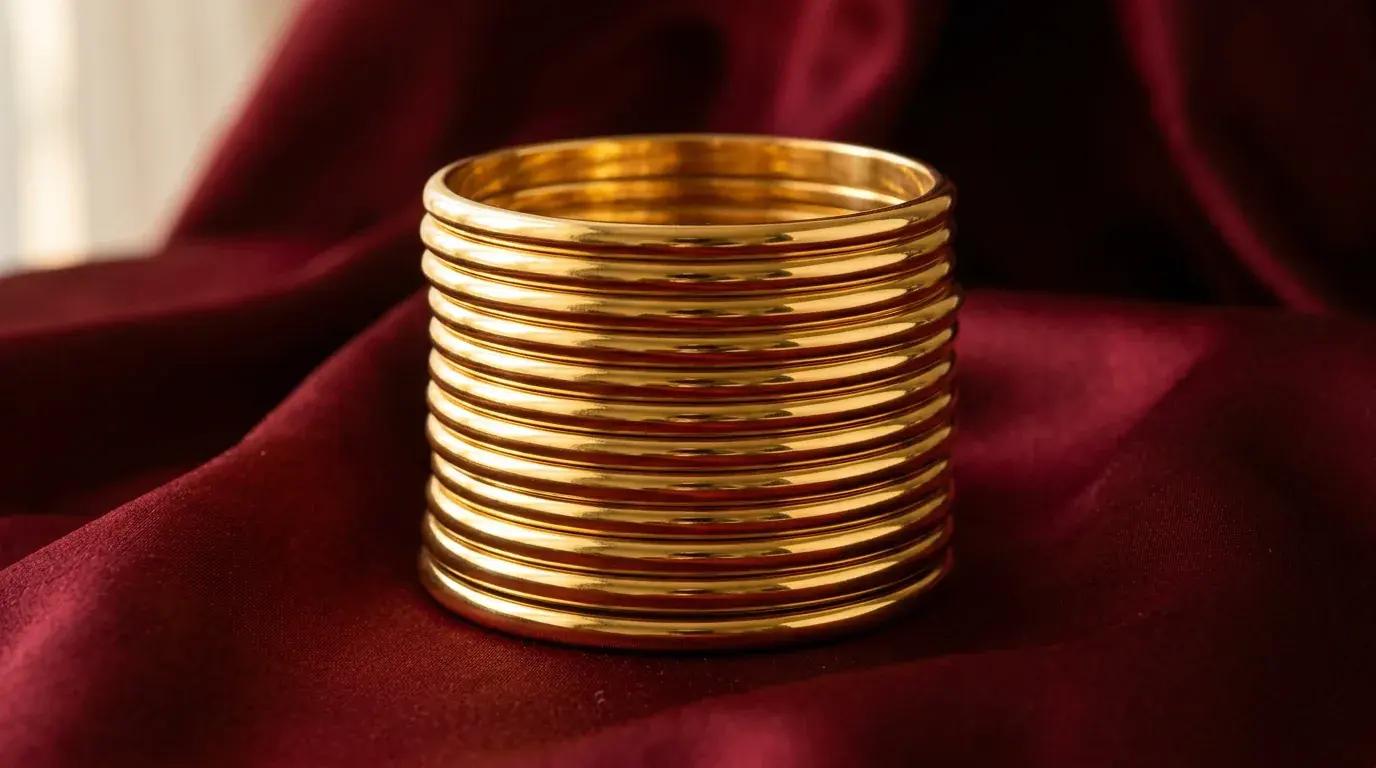
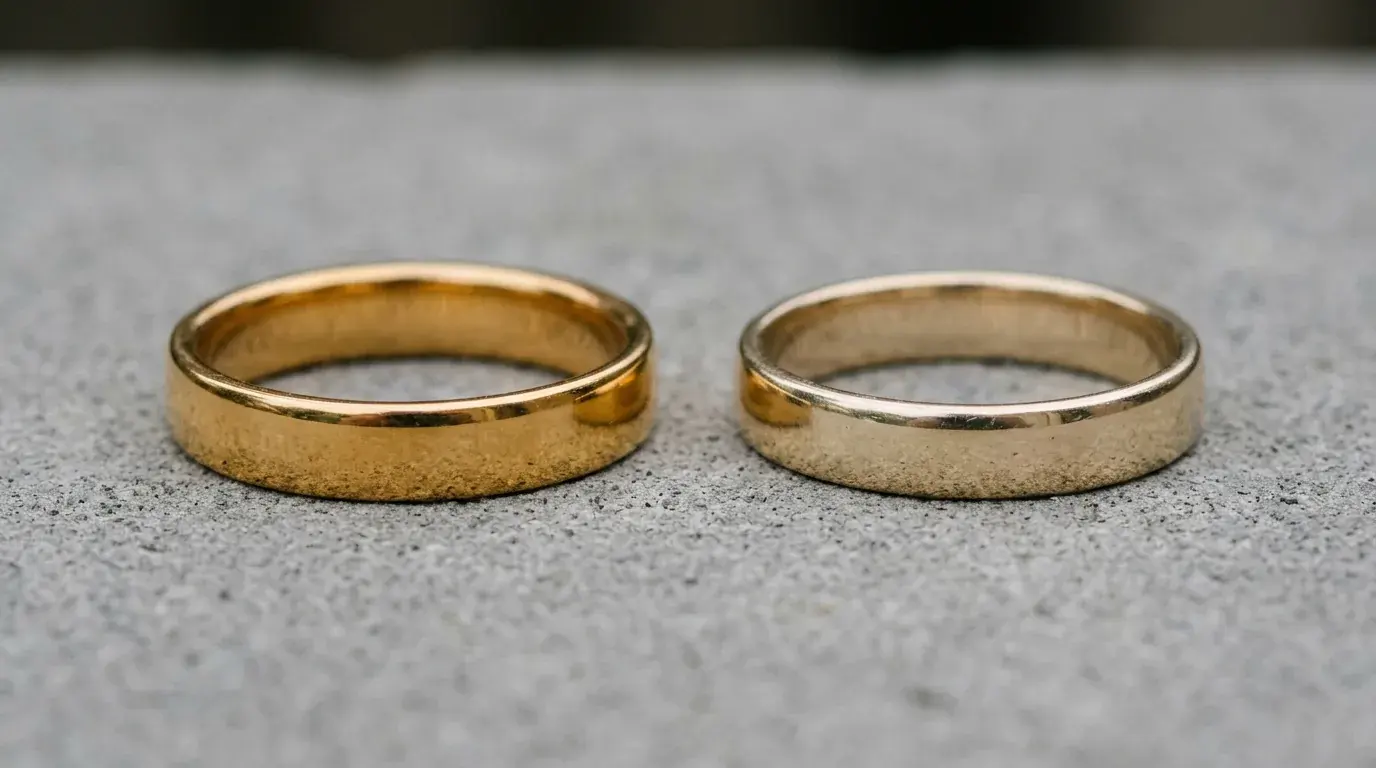
Plating does not wear evenly. It goes through at the points of highest friction, in a predictable order: the underside of a ring where it meets the adjacent finger, the edges of a bangle, the back of a pendant that rubs against clothing, and the inside faces of a chain's links where they move against one another.
That ordering matters because the damage appears where you notice it last and cannot polish it out. Once base metal is exposed it will often discolour and may irritate skin.
One nuance applies even to solid gold. White gold is a gold alloy usually finished with a thin rhodium plating to achieve the bright white colour buyers expect. That plating wears, and the piece gradually warms towards its underlying alloy colour. This is normal rather than a fault, and it is re-plated periodically as routine maintenance. A jeweller who explains this before the sale is one worth returning to.
Hallmarks, and what they do not tell you
A hallmark is a stamp indicating purity, and depending on the country it may also record the maker, the assay office and the year. In jurisdictions with compulsory independent assay, the mark is applied by a third party that physically tested the metal, which makes it strong evidence.
In jurisdictions without compulsory assay, a purity stamp may be applied by the manufacturer on its own authority. That is not necessarily dishonest, but it is a claim rather than a verification.
So the useful question is not "is it hallmarked" but "who applied this mark, and does that party test the metal". Ask. A reputable jeweller answers immediately.
What a hallmark never tells you is workmanship, stone quality, or whether the price is fair. It is a statement about metal purity and nothing else.
Buying by weight: the arithmetic, with invented numbers
Every figure here is invented. These are not real gold prices, real making charges or real margins. They illustrate how a total breaks down.
The price of a gold piece is roughly metal value plus making charge plus the retailer's margin. Metal value is weight multiplied by purity multiplied by the prevailing spot price.
Say spot gold is 60 per gram. A 10-gram piece at 750 fineness contains 7.5 grams of gold, so the metal content is worth 450. If the piece sells for 900, then 450 of what you paid is workmanship, brand and margin.
Now compare a second piece: 20 grams at 375 fineness also contains 7.5 grams of gold — identical metal value — but it is twice as heavy and will feel like a far bigger piece of jewellery. Sold at 700, it carries a smaller premium over metal.
Neither is the right answer. The first is a better store of value per unit of money; the second is a bigger, more wearable object. What the arithmetic does is let you see which one you are buying, instead of comparing two price tags that describe different things.
Weight-priced pieces, where the jeweller quotes metal weight and a stated making charge, make this visible by design. That transparency is precisely the appeal of houses that price this way, as we cover in the 999.9 gold guide.
Where solid gold is the wrong choice
An honest counterweight to everything above.
24k is too soft for a daily ring. It bends and scratches. Everyday rings that survive decades are usually 18k or lower for exactly that reason, and choosing a lower purity here is expertise rather than compromise.
Stone-set pieces are not a metal purchase. In a diamond ring the metal may be a minority of the value, so buying it for gold content is a category error. Judge the stone and its independent certification instead.
Alloy sensitivity is real. Some people react to particular alloying metals rather than to gold itself. If you have reacted to jewellery before, ask what the alloy contains.
Resale is at a discount to spot, always. A buyer of second-hand gold pays less than the metal is worth, because they carry refining and dealing costs, and the making charge is generally not recovered at all. Gold jewellery holds value far better than plated fashion. It is still not an efficient way to hold gold if pure exposure is what you actually want.
What to ask the jeweller
- What is the purity, expressed as both karat and fineness?
- What is the weight in grams, and is the price quoted by weight or as a fixed ticket?
- What is the making charge, stated separately from the metal?
- Who applied the hallmark, and does that body independently assay the metal?
- If it is white gold, is it rhodium plated, and what does re-plating cost?
- What alloying metals are used, and is the piece suitable for sensitive skin?
- What is your buy-back or trade-in policy, and on what basis is it calculated?
- For stone-set pieces, which laboratory certified the stone, and can I see the report?
For gifting, solid gold is the rare present that appreciates rather than depreciates; our gift guide leans on it for that reason. Buy plated only for fashion you expect to replace — and never confuse the two at the till. It is the same discipline behind quiet luxury.