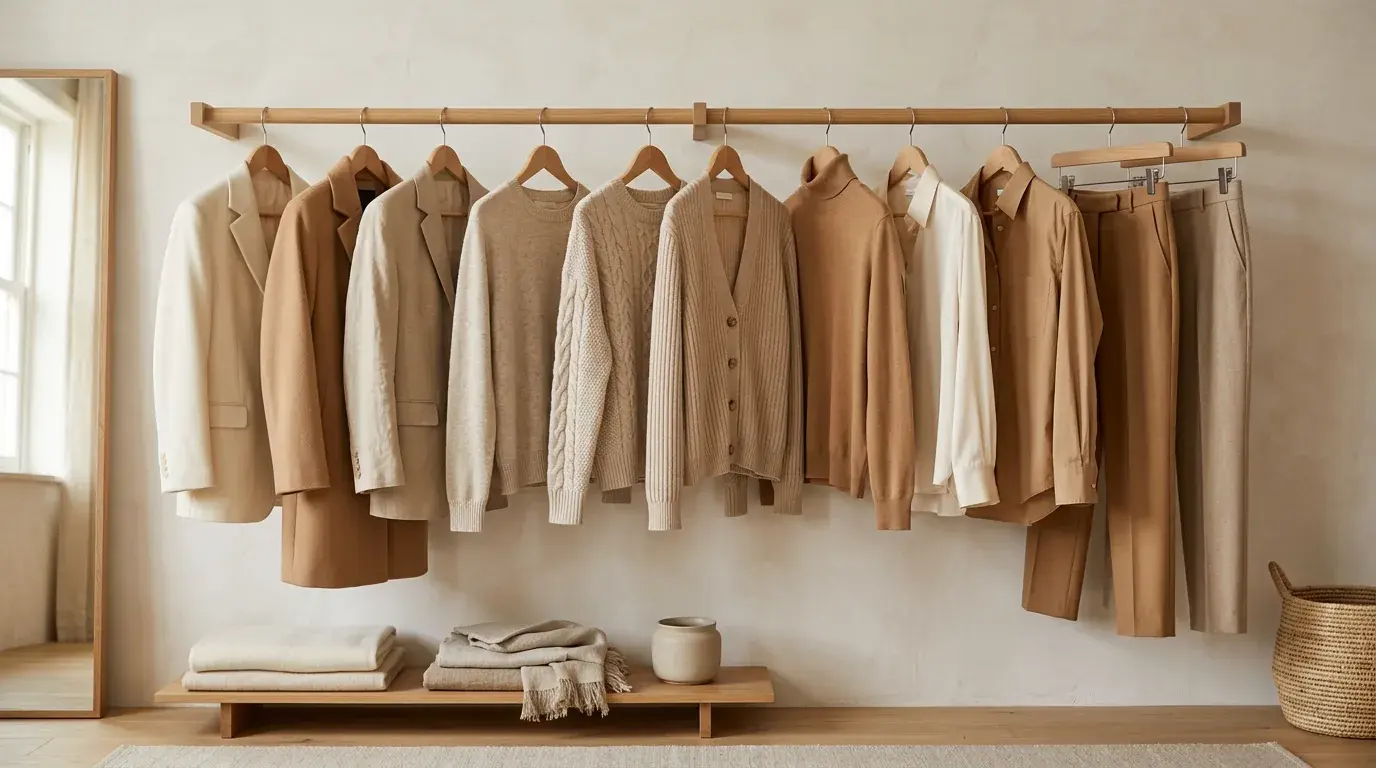
A capsule wardrobe sounds like a fashion fad but is really a spending strategy: own fewer, better pieces that all work together, and your cost-per-wear plummets while you look more put-together. Here is how to build one without overspending up front.
Step one: audit and be honest. Pull everything out, keep only what fits and what you actually wear, and note the gaps. Most people own far too much and wear a fraction of it — the opposite of quiet luxury, which we cover separately.
Step two: choose a neutral core. A few colours that combine freely (navy, grey, black, cream, a single accent) mean every piece works with every other. This is what makes a small wardrobe feel large.
Step three: invest in the anchors. One excellent coat — a technical piece like a Nobis earns this slot in a cold climate, per our Nobis review — one good bag built from full-grain leather (see our guide to spotting quality leather), and one watch from our under-£1000 roundup. These three carry everything else.
Step four: add quietly valuable accents. A piece of solid gold dates less than trend jewellery and holds value; our gold guide explains why. Resist logo-heavy add-ons that scream rather than support.
The arithmetic that makes it work, with invented numbers
Every figure below is invented. They are not real prices for any garment. They are here to make the mechanism visible.
Cost per wear is total cost divided by the number of times worn. That is the whole idea, and it produces answers that contradict the price tag surprisingly often.
A jumper at 40 that pills after twenty wears costs 2.00 per wear. A jumper at 200 in a better yarn, worn a hundred times a year for four years, costs 0.50 per wear. On these invented numbers, the expensive jumper is a quarter of the price.
Now the honest reverse case. A jacket at 600 worn six times a year for five years costs 20.00 per wear. A jacket at 120 worn the same thirty times costs 4.00. Expensive does not beat cheap; frequency beats everything. This is why the audit comes first — you need to know what you actually wear before you know where the money belongs.
And a third case that decides more wardrobes than either: a beautiful garment that does not fit properly is worn twice. Its cost per wear is enormous whatever it cost, which is why tailoring belongs in the budget rather than in the aspiration.
Proportions, not a shopping list
Every capsule article eventually prints a numbered list of garments, and every such list is wrong for most readers, because it is written for one climate and one occupation.
The transferable version is a set of proportions. Roughly: enough of the things you wear daily that laundry never forces a bad choice, one layer for each temperature band your climate actually produces, one outfit that works for the most formal thing you do in a normal year, and shoes for the three surfaces you actually walk on.
Build that from your own diary rather than from a list. If you work outdoors four days a week, your capsule is mostly workwear and one good coat. If you are in meetings daily, it is mostly tailoring. Both are capsules; neither looks like the other.
Fit is the entire thing
The single largest visual difference between an expensive-looking wardrobe and an ordinary one is fit, and fit is cheap relative to garments.
Budget for alterations as a line item rather than an afterthought. Sleeve length, trouser length, taking in a waist and adjusting a shoulder are routine work, and the first three are inexpensive. Shoulders are the exception — a jacket whose shoulders do not fit cannot be economically corrected, which is why the shoulder is the one measurement to buy for and alter everything else around.
Two practical rules. Buy for the larger measurement and have it taken in, because letting out is limited by the seam allowance that exists. And take a garment to the tailor within the returns window, so that if it turns out to be uncorrectable you still have the option to send it back.
Fabric literacy
Three things on a label tell you most of what you need.
Fibre content is stated by law in most markets. Natural fibres crease more, breathe better and generally last longer; synthetics resist creasing and wear out faster in ways that show. Blends are compromises, and whether a particular compromise is good depends on what the garment is for.
Weight, usually in grams per square metre, is rarely printed but is often available if you ask. It is the difference between a shirt that hangs and one that clings, and between a coat that is warm and one that is merely thick.
Construction details you can see: whether a pattern matches across a seam, whether buttons are sewn with a shank, whether seams are finished inside. These take time to do and are not done on garments made to a price.
The sequence over twenty-four months
Building a capsule in one purchase is expensive and usually produces a wardrobe assembled to a theory rather than to a life. Sequenced, it costs the same as normal shopping and lands better.
- Months one to three: audit, remove what does not fit or is not worn, and repair or alter what is close.
- Months four to six: replace the single item you wear most often, in the best version you can afford.
- Months seven to twelve: the outerwear anchor, bought at the end of a season rather than the start.
- Months thirteen to eighteen: shoes, one pair at a time, with resoling available.
- Months nineteen to twenty-four: the bag, the watch, and one accent piece.
- Throughout: replace only on genuine failure, never on boredom.
The honest limits
Boredom is real and is not a character flaw. A very small wardrobe worn constantly gets tiring, and the standard advice to simply endure that is unhelpful. Building in two or three pieces bought for pleasure rather than utility is what makes the discipline survivable.
Some jobs impose their own uniform. Where clothing is prescribed, or where work destroys garments, the capsule applies to the rest of your life and not to the working day. Do not spend anchor money on things that will be ruined.
Bodies change. After illness, pregnancy, a change in training, or simply time, a wardrobe built for a previous size is a wardrobe of reproaches. Build in the assumption that some of it will need altering, and prefer garments with alteration allowance.
Four seasons cost more than one. In a climate with genuine winter and genuine summer, you are effectively building two capsules that share a middle. That is a larger project than most capsule writing admits, and pretending otherwise leads to being cold.
Step five: maintain and replace slowly. Care for what you own, replace only when something genuinely wears out, and upgrade one anchor at a time. The maths works: a capsule of excellent pieces costs less over five years than a churn of cheap ones — and looks far better doing it.