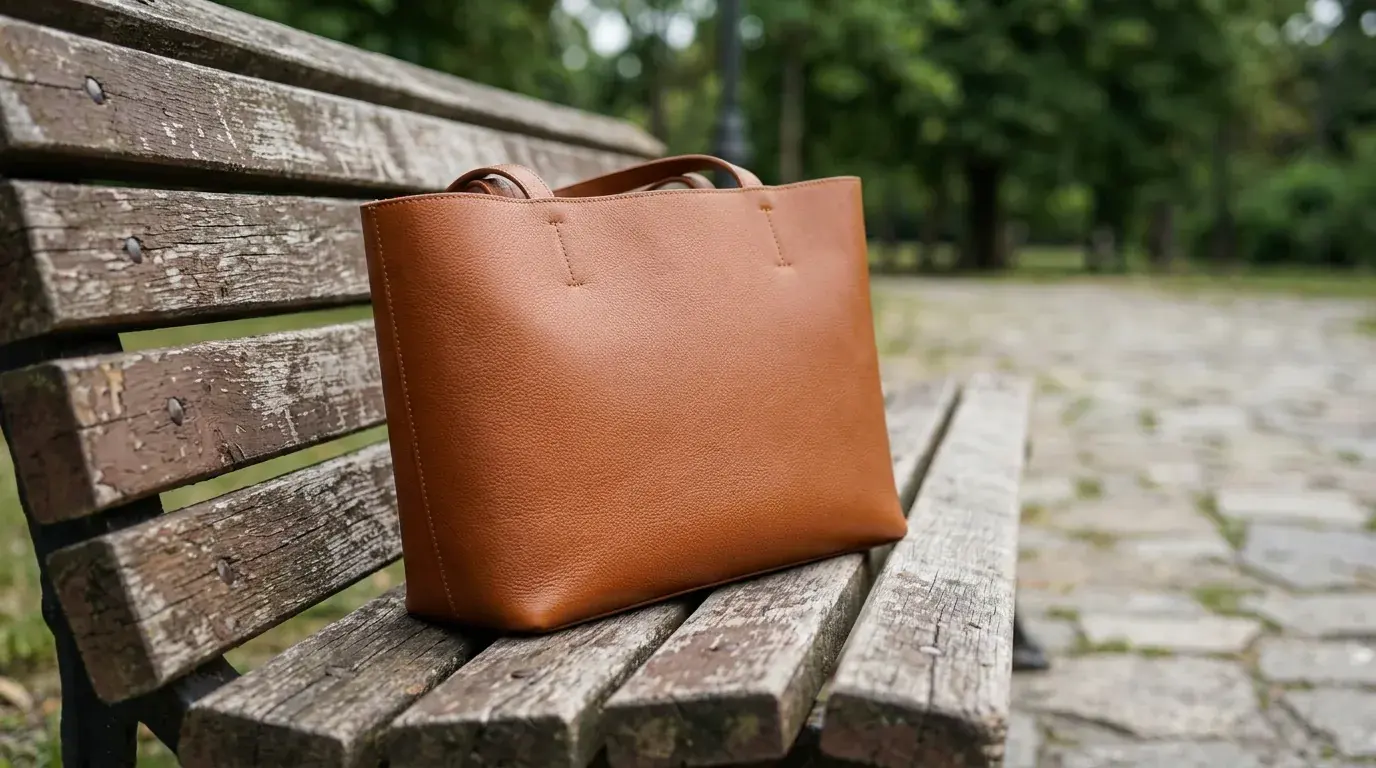
A good leather bag is one of the best value-per-year purchases in the wardrobe — if you buy the right one. The difference between a bag that ages into a patina and one that peels within two winters comes down to a few checkable details, none of which require an expert eye.
Start with the leather itself. Full-grain means the whole hide surface, blemishes and all, which is exactly what makes it strong and lets it patina rather than flake. Be wary of reading too much into the other labels: the familiar "grade ladder" that puts 'genuine leather' near the bottom is a trade convention, not a standard — 16 CFR Part 24, which governs how leather may be described in the US, defines no grading system and never uses the phrase 'genuine leather' at all. We go deeper on what the labels do and do not tell you in our guide to spotting quality leather.
Then the construction. Look at stitch density and straightness, check that stress points are reinforced or riveted, and weigh the hardware in your hand — solid metal zips and clasps outlive the plated pot-metal on cheaper bags. These are the same quality cues that define quiet luxury generally.
Brand matters less than people think at this level, but a maker with a track record in leather goods or technical outerwear — the kind of construction you see in a brand like Nobis — tends to apply the same standards across the board. Buy the construction, not the logo.
Tanning: the decision made before the bag was cut
How a hide was tanned shapes everything about how it will age, and it is rarely mentioned on a product page.
Vegetable tanning uses tannins from bark and plant matter. It is slow, it produces firm leather with a warm tone, and it is the tanning that develops the deep patina people mean when they talk about leather improving with age. It also darkens in sunlight, marks with water, and is stiff until it is broken in.
Chrome tanning uses mineral salts, is much faster, and produces softer, more uniform, more water-tolerant leather that takes colour readily. The great majority of leather goods are chrome tanned, and that is not a mark against them.
Neither is the good one. They are suited to different objects. A structured briefcase that you want to develop character over fifteen years wants vegetable tanning. A soft everyday shoulder bag that will meet rain wants chrome. What matters is that the maker names the tanning at all — the ones doing careful work usually do, and the silence on the specification is itself information.
Construction details that predict lifespan
Leather quality gets all the attention and construction is what actually fails.
Stitch type. A saddle stitch is worked with two needles so that each stitch locks independently; if one length is cut, the seam does not unravel. Machine lockstitch is faster and entirely adequate, but a cut thread can run. On stress-bearing seams, ask which was used.
Thread. Bonded nylon or polyester survives abrasion and damp far better than cotton. Thread is cheap and replacing a failed seam is not, so this is a place where good makers do not economise.
Edge finishing. Edges are either painted, burnished, folded or left raw. Folded-and-stitched edges last longest, burnishing looks beautiful and needs occasional attention, and painted edges are fine until the paint chips. Raw, fuzzy edges on an expensive bag are a straightforward tell.
Hardware. Weigh it. Solid brass or steel outlasts plated pot-metal, which pits and then breaks. Zips are the component most likely to end a bag's life, and a named zip maker stamped on the pull is a meaningful signal because it means replacement parts exist.
Anchoring. Look at where the strap meets the body. That joint carries the entire loaded weight of the bag through a small area, and it should be reinforced, riveted or backed with a second layer of leather. Stitched straight through a single unbacked panel is where bags tear.
Lining. A lining is not decoration; it stops the interior abrading and holds the shape. Unlined bags of thin leather stretch into shapeless sacks.
The failure points, in order
Bags do not wear out evenly. In rough order of what goes first: the zip, the strap anchors, the corners, the handle where your hand sits, the lining, and finally the leather itself. Full-grain leather is very often the last thing standing on a bag that has already become unusable for another reason.
That ordering is the practical argument for judging construction over leather grade. A superb hide anchored with four stitches into an unbacked panel will fail before an ordinary hide riveted properly.
Cost per use, with invented numbers
These numbers are made up and are not any brand's prices. They demonstrate a method.
Bag A costs 150 and lasts three years of daily use before the zip fails unrepairably. Bag B costs 700, is carried daily for twelve years, and has one zip replaced at 60 in year seven.
Bag A over twelve years: four purchases, 600. Bag B over twelve years: 760. On these invented figures the expensive bag is slightly more expensive, not less — and yet it is still the better buy, because you had one bag you liked for twelve years instead of four you tolerated for three.
Change one input and it moves decisively. If Bag B is used three times a week rather than daily and lasts twenty years, or if Bag A fails in two years rather than three, the arithmetic tips hard. The method is what to take away: estimate honestly how often you will carry it, and estimate the repair rather than pretending nothing will break.
Care that actually extends life
- Empty it weekly; weight left sitting in a corner is what deforms leather permanently.
- Store it stuffed with acid-free paper or a cloth, upright, in a breathable dust bag rather than plastic.
- Keep it away from radiators, car parcel shelves and direct sun, all of which dry and crack leather.
- Let a wet bag dry slowly at room temperature, never with heat, and never wipe salt marks while wet.
- Condition sparingly and only when the leather feels dry; over-conditioning softens structure and darkens finish permanently.
- Have a failing zip replaced at the first sign of stiffness, not after it splits.
- Rotate between two bags if you can; leather recovers better with rest days.
The honest limits
Full-grain is not automatically right for every bag. It is heavier, and on a large tote that weight is carried by you all day. A lighter chrome-tanned hide, or a technical fabric with leather trim, is the better tool for some jobs and choosing it is not a compromise.
Structured bags hold their shape and show every scuff; unstructured bags forgive scuffs and slump. Neither is superior, but people frequently buy the first and want the second.
And brand-name resale is a narrow phenomenon. A handful of houses have a genuine secondary market; almost everything else is worth what a stranger will pay for a used bag, which is little. Buy for the twelve years of use, not for the exit.
Care extends life dramatically: condition twice a year, store stuffed and dust-bagged, keep it out of direct heat. A well-chosen bag becomes a decade-long companion and, like the gold and watches we cover elsewhere, holds value far better than disposable fashion. Pair it with a considered watch from our under-£1000 roundup and the whole outfit reads deliberate.