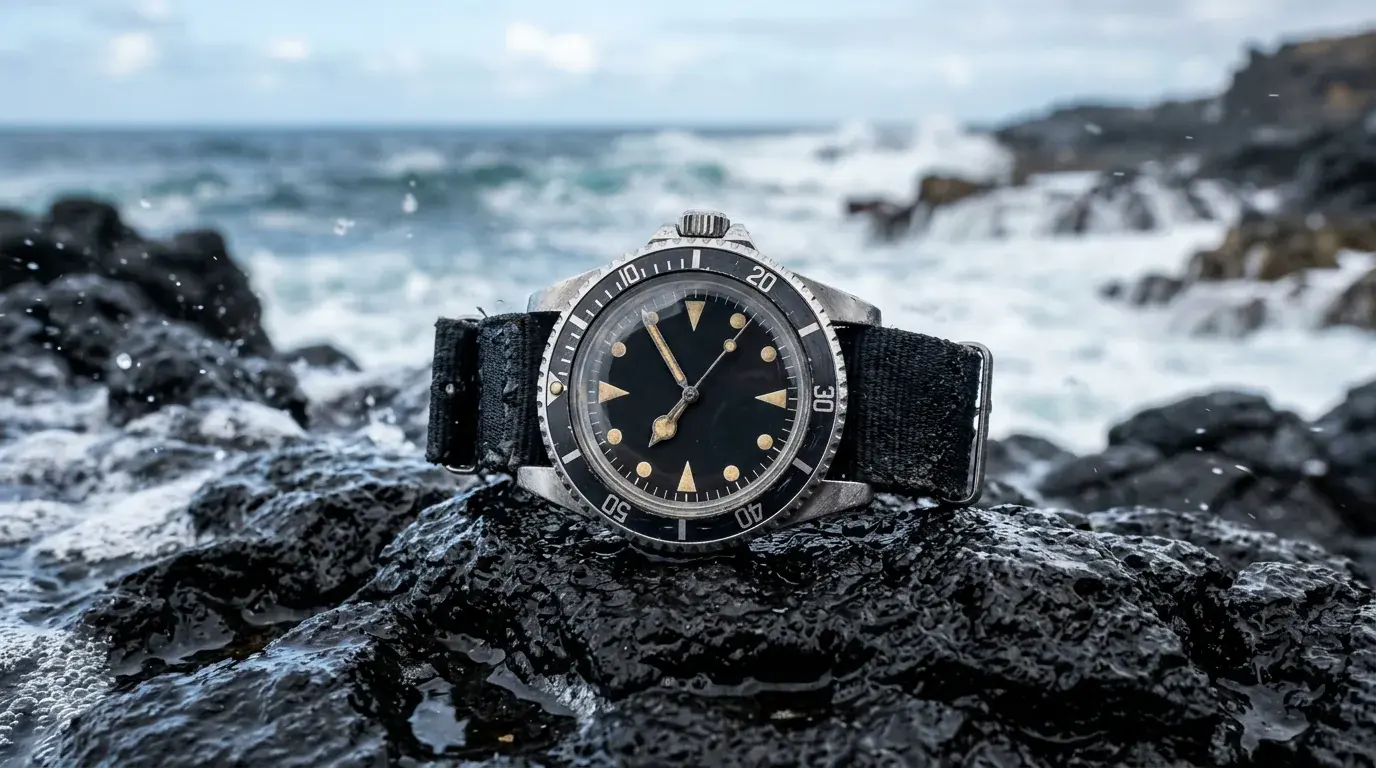
Luminox built its reputation on one feature: tritium gas tubes that glow continuously for years without needing light to charge, unlike the lume on most watches. For a tool watch you can read instantly in the dark, nothing in the price bracket comes close.
Beyond the glow, these are genuine tool watches — high water resistance, robust cases, and no-nonsense legibility. They are built to be used, not babied, which makes them a refreshing antidote to watches you are afraid to scratch. That usability is the quiet argument for a Luminox as a second watch: the one you reach for on the days a dress piece feels too precious, the watch that goes hiking, sailing and travelling without a second thought.
Value is the story. You get tritium illumination and real dive-watch specs for a fraction of what the established Swiss dive names charge. It is the same value logic that runs through our everyday-watch roundup: pay for the function, not the badge.
Strap choice changes the character completely — rubber for the water, leather or nylon for land. If you go leather, our guide to spotting quality leather will save you from the cheap straps that crack within a season.
Tritium tubes versus ordinary lume
These are two completely different technologies that produce a superficially similar result, and the difference decides whether the watch is readable at four in the morning.
Ordinary watch lume is photoluminescent. It absorbs light and re-emits it, which means it must be charged and it fades. Charge it under a bright lamp and it is dazzling for a few minutes, useful for an hour or two, and effectively gone by the middle of the night. A watch that has been under a sleeve all evening has no charge at all.
A tritium tube works differently. It is a sealed borosilicate glass capsule coated internally with a phosphor and filled with tritium gas. Tritium is a radioactive isotope of hydrogen; as it decays it emits low-energy electrons that excite the phosphor, and the phosphor glows. Nothing charges it and nothing switches it off. It is dimmer than freshly charged lume and it is still doing exactly the same thing at four in the morning, in a cave, after a week indoors.
The trade-off is predictable and worth knowing before you buy. Tritium's decay is a physical constant with a half-life of a little over twelve years, so the tubes get gradually dimmer over the life of the watch rather than failing suddenly. A very old tritium watch is still legible; it is simply not as bright as it was. Tube replacement is possible but is specialist work and belongs with the maker rather than a general watchmaker.
The tubes are sealed and are used in consumer watches under the relevant national regulations. If one is ever physically damaged, that is a repair for the manufacturer, not a job for a local shop or a workbench.
Reading a dive-watch specification honestly
There is an international standard for diver's watches, ISO 6425, and it is far more demanding than a water-resistance figure alone. It sets requirements covering legibility in darkness, a bezel that can only rotate in one direction so that a mistimed turn overstates rather than understates remaining time, resistance to shock, magnetism, salt water and thermal shock, and it requires compliant watches to be marked accordingly.
The practical point: a high pressure rating and compliance with the diving standard are two different claims, and only one of them involves the full test regime. Plenty of excellent watches carry a high rating without being certified diver's watches, which is fine as long as you know which you are buying.
Water resistance itself is widely misread. The number comes from a static pressure test performed in a laboratory on a new watch. It is not a depth you may swim to, because moving through water generates dynamic pressure that a static test does not reproduce, and because the seals that produce the rating harden with age and heat. Treat the figure as a robustness indicator and have the seals tested if you swim with it.
Bezel behaviour is worth checking in person. A good bezel has firm, positive clicks with no back-play; a poor one drifts, which on a timing bezel is the one failure that actually matters.
Where these watches genuinely fit
The best argument for this category is not that it replaces your main watch. It is that it removes the anxiety from the days when your main watch is the wrong tool.
A watch you are slightly afraid of gets left at home for exactly the activities where you most want to know the time — sailing, hiking, working outdoors, travelling somewhere you would rather not advertise an expensive object. A tool watch that owes you nothing goes everywhere.
That is also why it pairs well rather than competes. One dress or everyday piece from our under-£1000 roundup and one genuinely rugged watch covers almost every situation between them, which is the same two-anchor logic behind the capsule wardrobe tutorial.
The honest limits
The movement is a commodity. Most of the range runs quartz modules that are accurate, reliable and entirely unremarkable. You are paying for the illumination, the case and the specification, not for horology.
Case sizes run large. These are tool watches and they are dimensioned as such. Check lug-to-lug rather than diameter, because a large case with long lugs on a slim wrist is the most common regret in this category.
Resale is poor. As with almost everything under four figures, buy it to use.
The tubes dim. Slowly, predictably, over more than a decade. That is a feature of the physics rather than a defect, but it means "glows for years without charging" is a claim with an end date on it.
What to check before you buy
- Does the model actually carry tritium tubes, and are they on the hands, the indices, or both?
- Is the watch described as meeting the diving standard, or does it merely carry a pressure rating?
- What is the lug-to-lug length, and how does it compare with a watch you already wear?
- Is the bezel unidirectional, and does it click firmly with no play?
- Is the crystal sapphire, and is it treated to cut reflections?
- What is the strap fitting width, and is it a common size with a wide aftermarket?
- Who handles service and tube work in your country?
- Is the warranty supplied by the manufacturer through this seller?
Buying: Luminox runs brand discount codes through authorised retailers; we track live ones on the deals board. The Luminox range at First Class Watches carries full warranty and is the straightforward place to compare the lines side by side.