Leather is where buyers get fooled most often, because clever finishing makes cheap leather look expensive in a shop. The good news: a few checks you can do in thirty seconds reveal the truth, and none require expertise.
Check one — the wording on the label, and what it is actually worth. You will find a tidy four-rung "leather grade" ladder repeated all over the internet: full-grain at the top, then top-grain, then 'genuine leather', then bonded. It is worth knowing that this ladder has no legal standing. The US rules that govern how leather may be described, 16 CFR Part 24, define no grading system at all: 'genuine leather' does not appear in them once, and 'top grain' appears only inside worked examples of how to word a description ("Top Grain Cowhide With Plastic Frame Covering"), never as a defined rung. So a label reading 'genuine leather' tells you the material is leather rather than an imitation. It does not tell you it is a low grade, and it does not tell you it is a high one.
The one part of that ladder with real regulatory teeth is the bottom. 16 CFR §24.2(f) covers leather that has been ground, pulverised, shredded, reconstituted or bonded, and requires that it be disclosed rather than passed off as solid hide. That is the distinction actually worth checking on a label. For everything above it, the terms are trade descriptions used loosely and inconsistently between makers — which is exactly why the physical checks below matter more than the wording.
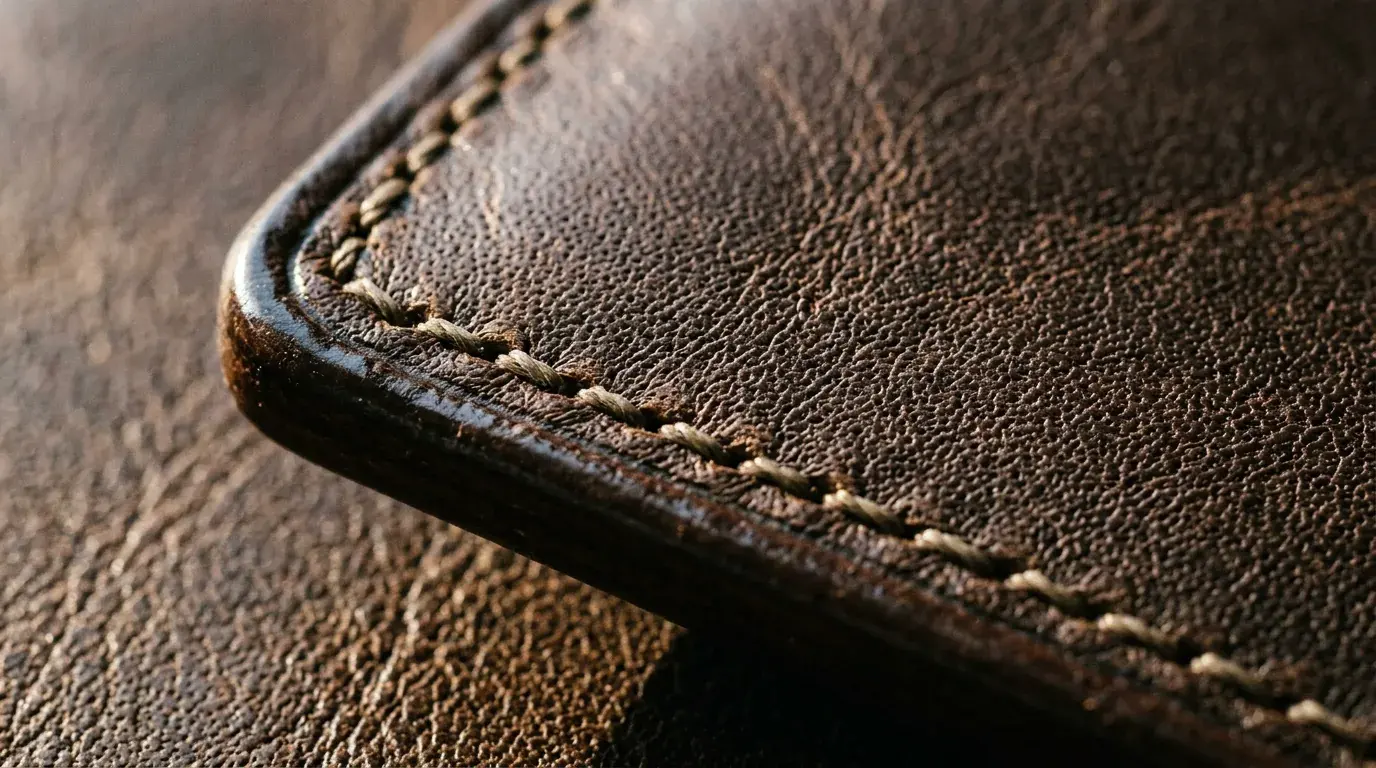
Check two — the grain and surface. Real quality leather has subtle, irregular natural grain and small imperfections. A perfectly uniform, plasticky surface usually means a heavy synthetic coating hiding poor leather underneath.
Check three — edges and stitching. Quality edges are painted or burnished smooth; raw, fuzzy or peeling edges signal corners cut. Stitching should be dense, even and straight, with reinforced stress points — the same construction cues we list in our bags-that-last guide.
Check four — smell and feel. Real leather smells like leather, not chemicals or plastic, and feels supple and warm rather than stiff and cold. Trust your senses; they are surprisingly reliable.
Check five — the cut edge and the cross-section. Wherever leather is cut and left visible, on a strap end or inside a pocket, look at the layer structure. Solid leather shows a consistent fibrous cross-section; a coated split shows a distinct surface film sitting on a fuzzy substrate, like icing on a sponge. This is the single most informative thirty seconds available to you and almost nobody looks.
Check six — the flex test. Bend a section gently. Good leather wrinkles into fine, irregular creases that relax when released, because the fibre structure is doing the work. Heavily coated leather creases into sharp, regular folds and the coating may lift or whiten along the fold. On a bag, flex a corner; corners are where this shows first and where the item will eventually fail.
Check seven — the back. Turn the piece over or look inside. The reverse of solid leather is fibrous and slightly rough. A woven textile backing means you are looking at a coating bonded to fabric, which is a different product with a different lifespan.
Tanning, and what it changes about your expectations
Two hides of identical quality can behave completely differently because of how they were tanned, and this explains most of the disagreements people have about whether a piece is any good.
Vegetable-tanned leather is firm, warm-toned, and develops the deep patina that leather enthusiasts mean when they say leather improves. It also darkens in sunlight, marks with water, and feels stiff until broken in. If you buy vegetable-tanned and expect soft and waterproof, you will conclude it is poor quality when it is simply doing its job.
Chrome-tanned leather is softer immediately, more uniform in colour, more tolerant of damp, and takes bright colours that vegetable tanning cannot. It does not patina in the same way. Most leather goods in the world are chrome tanned and most of them are perfectly good.
Neither is superior. They are suited to different objects, and the useful signal is whether the maker states the tanning at all. Makers doing careful work generally do; silence on the specification is itself a small piece of information.
What the checks cannot tell you
An honest limit on everything above, because a checklist presented as infallible is worse than no checklist.
Finishing can hide a great deal. Modern surface treatments are good enough that a heavily corrected hide can pass a casual look. The cut-edge and flex tests are the ones that survive good finishing; the surface-grain test is the one most easily defeated.
A superb hide can be assembled badly. Leather quality and construction quality are independent variables. A beautiful hide stitched with cotton thread into an unbacked strap anchor will fail long before an ordinary hide riveted properly, which is why our bags-that-last guide spends more time on construction than on hides.
Grade language has no legal backing above the bottom rung. As set out above, the only part of the familiar ladder with regulatory content is the disclosure requirement for ground, shredded or bonded material. Everything above that is trade usage, applied inconsistently.
Exotic and specialist leathers follow different rules and may also carry species-protection documentation requirements when crossing borders. If you are buying one, that paperwork is part of the purchase.
Buying online, where you cannot touch it
The checks above need hands. Online, you are reduced to asking questions, so ask better ones.
- What is the tanning method, and what is the leather's origin?
- Is the leather solid through its thickness, or is it a split with a surface coating?
- Can you send a close photograph of a cut edge and of the reverse side?
- How are the edges finished — folded, burnished, painted or raw?
- What thread is used on load-bearing seams?
- Are the strap anchors reinforced or riveted, and can I see them?
- What is the returns window, and who pays return shipping?
- Are repairs offered, and are replacement parts such as zips available?
A seller who answers all eight plainly is usually selling something worth buying. A seller who responds only with adjectives has told you something too.
Care, by leather type
Vegetable-tanned pieces want occasional conditioning, protection from prolonged sun, and patience while they break in. Chrome-tanned pieces want less conditioning than people give them and benefit more from simply being wiped and dried properly.
Both want the same three things: no direct heat when drying, no plastic storage, and no over-conditioning, which softens structure and permanently darkens finish. When leather does get soaked, let it dry slowly at room temperature and condition afterwards rather than during.
Apply these and you will buy leather once instead of repeatedly — exactly the logic behind our capsule wardrobe tutorial and the quiet luxury approach across this site. The thirty-second check pays for itself many times over.