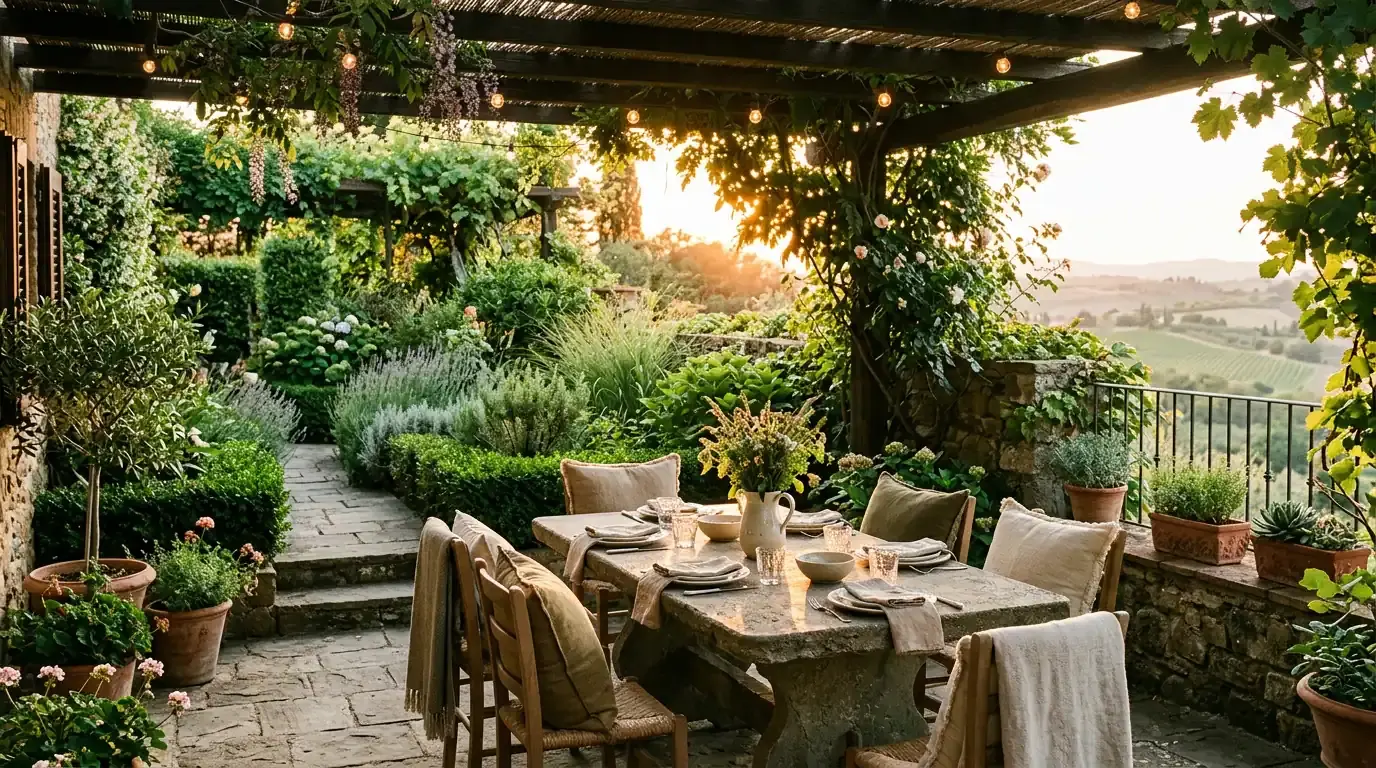
Done well, an outdoor space becomes the best room in the house for the warm months. Done cheaply, it becomes a collection of faded plastic within a couple of summers. The difference is buying fewer, better things.
Furniture first: weather-resistant materials — powder-coated aluminium, teak, all-weather wicker over a sound frame — last and develop character rather than simply degrading. Buy a smaller set in good materials over a large set in poor ones.
Lighting transforms an evening garden. Warm, low-level lighting — festoon strings, path lights, a few lanterns — turns a functional yard into somewhere you linger. It is inexpensive relative to its effect, echoing the lighting advice in our home-upgrades guide.
Planting is where restraint pays again: a structured, repeated palette reads as designed, while a scattergun of clashing colours reads as busy. Evergreen structure plus a few seasonal highlights gives you year-round form for less ongoing work.
Start with how the space is actually used
Almost every disappointing garden is a garden furnished for an imagined life rather than the real one. Before choosing anything, answer four questions honestly.
How many people, how often? Most households eat outside in twos and threes and host in larger numbers a handful of times a year. Buying a twelve-seat table for the handful of times means living with a twelve-seat table for the rest of the year. Buy for the common case and borrow, hire or improvise for the exception.
At what time of day? A space used at breakfast wants morning sun and shelter from wind. A space used after work wants evening light and somewhere to put a glass down. These are different layouts, and the sun does not move to suit furniture.
In what weather? Be specific rather than optimistic. If your climate delivers a dozen genuinely warm evenings a year, the sensible investment is in shelter and heat rather than in more seating.
Who maintains it? This is the question that decides more than any other, and it is the one covered last in most garden writing. A design nobody has time to maintain becomes an eyesore faster than no design at all. Why that makes a low-maintenance scheme the more valuable one, not the lesser one, is argued in why a low-maintenance property is worth more than a cheap one.
Materials, and how each one ages
Teak and similar dense hardwoods. Oily, stable, and genuinely capable of decades outdoors. Left untreated they silver to a soft grey, which is either the point or a disappointment depending on your taste; oiled, they hold their honey colour and demand annual attention. Check that the timber is from a certified responsibly managed source, and treat that claim as a specification rather than a sentiment.
Powder-coated aluminium. Light, does not rust, and holds colour well. The failure mode is chipping of the coating, usually at feet and corners, after which the exposed metal is still aluminium and still does not rust — which is why this is a forgiving choice.
Steel. Strong and heavy. Untreated it rusts; galvanised or well-coated it lasts. Weathering steel that develops a stable rust patina is a deliberate look and it will stain paving beneath it, permanently, so plan for that.
All-weather wicker. The name describes the woven synthetic strands, not the thing underneath. The frame is what matters. Woven resin over an aluminium frame can last many years; the same weave over an untreated steel frame will fail from the inside out and cannot be repaired.
Concrete and stone. Effectively permanent, effectively immovable, and cold to sit on for much of the year. Excellent for tables and low walls, questionable for seating without cushions.
Composite decking. Low maintenance and dimensionally stable compared with timber. It gets hot in direct sun, and cheaper boards fade unevenly. Ask for a sample and leave it outside for a season before committing to a whole deck.
Hard landscaping before furniture
The order most people work in is backwards. Furniture is bought first because it is the fun part, and then it sits on a surface that does not suit it.
Get the surface, the levels and the boundary right first. A flat, well-drained, generously sized terrace with a defined edge makes cheap furniture look intentional. An undersized or uneven surface makes expensive furniture look stranded.
Size the terrace by drawing the furniture on it, including the space to push chairs back. The most common error in small gardens is a paved area that technically fits a table and does not fit people using it.
Lighting outdoors
Outdoor lighting follows the same rule as indoor lighting: warm, low and layered beats bright and overhead.
Practically, that means light at three levels — a little at ground level along paths, a little at table height, and a little washing a wall or a tree. Anything mounted high and pointing down turns a garden into a car park.
Two specifications matter. Check the ingress protection rating is appropriate for where the fitting will actually sit, because a fitting rated for a sheltered wall is not rated for standing in a border that floods. And check the colour temperature, because cool white outdoors is the single fastest way to make a garden feel municipal.
Be a good neighbour about it. Light that spills over a boundary or into a bedroom window is a genuine nuisance, and low-level lighting avoids it almost automatically.
Planting for structure
Restraint reads as design. A repeated palette of a few plants, used in groups, looks deliberate; one of everything looks like a collection.
Build the frame from evergreens and structural forms that hold the space in February, then add seasonal interest into that frame. A garden that only works in June is a garden you look at from indoors for ten months.
Match the plant to the conditions rather than to the photograph. Sun, soil and exposure decide what survives, and a plant fighting its position needs constant intervention — which brings us back to the maintenance question.
The honest limits
The expensive garden is often the high-maintenance one. Clipped hedging, bedding schemes and container planting all look superb and all require regular, skilled work. If nobody is doing that work, the design is a liability. Choosing a lower-maintenance scheme is not settling; it is designing for the resources that exist. For a lawn at a house that stands empty for weeks at a time, a robot mower is one way to keep it cut between visits; Anthbot, sold through its official EU store, is one we link to.
Outdoor furniture wears faster than you expect even in good materials, because ultraviolet light degrades fabrics and finishes continuously. Cushions are consumables. Buy covers, or storage, or both. When the frames are sound and only the cushions have gone, made-to-measure replacements are cheaper than a new set; Gardenista, which makes garden and patio seat cushions to order in Birmingham, UK, is one maker we link to.
A short season changes the maths. Where the usable outdoor season is genuinely brief, shelter and heat buy more usable evenings than a larger seating set does.
What to check before you buy outdoor furniture
- What is the frame made of, underneath any weave or coating?
- Is the timber certified from a responsibly managed source, and is that stated on the product page?
- Are fixings stainless steel, and can they be tightened or replaced?
- Are replacement cushions and covers available separately, and for how long?
- What is the stated warranty, and does it cover the finish as well as the structure?
- Where will it be stored, or covered, out of season?
- Can you physically move it to clean underneath, and does it stack?
- Will it stain the surface it stands on?
For furniture and outdoor pieces, Best Choice Products, which sells home and outdoor furniture, is one range we link to; put the checklist above to anything you consider, from any seller. Spend on the frame and the materials; everything else you can layer in over seasons. For the same thinking indoors, see home upgrades that feel expensive, and for interiors, outdoor rooms and home technology together, our House & Garden department.
Frequently asked questions
What outdoor furniture material lasts longest?
Dense hardwoods such as teak can last decades outdoors, and powder-coated aluminium does not rust even when the coating chips. Stone and concrete are effectively permanent but immovable. For all-weather wicker, judge the frame underneath: resin over aluminium lasts, the same weave over untreated steel fails from the inside.
Does teak garden furniture need oiling?
Only if you want to keep its honey colour. Left untreated, teak silvers to a soft grey without harming the wood; oiled, it holds its colour but needs attention every year. Either way, check the timber comes from a certified, responsibly managed source.
What is the best lighting for a garden or terrace?
Warm, low and layered: a little light along paths at ground level, some at table height and some washing a wall or tree. Avoid cool white and high downlights, check each fitting's ingress protection rating suits where it will sit, and keep light from spilling over the boundary.
Should you do the landscaping or buy the furniture first?
Landscaping first. A flat, well-drained, generously sized terrace with a defined edge makes modest furniture look intentional. Size it by drawing the furniture on it, including room to push chairs back.
How do you make a garden low-maintenance?
Plant a small, repeated palette built on evergreen structure, match plants to the sun, soil and exposure you actually have, and avoid clipped hedging, bedding schemes and containers unless someone skilled will tend them. Buy fewer, better pieces of furniture and plan where they are stored or covered out of season.