A trophy property is not a larger house. Past a certain scale it becomes an operation, and operations have payroll, rotas, statutory obligations and single points of failure. The purchase price is negotiated once; the staffing bill recurs every year for as long as you own, and it is the line most often missing from the model.
This guide takes the staffing and systems half of ownership. The full annual picture is in what a trophy property costs per year, and what all of it does to a notional return is in carrying cost and your return.
The roles that appear whether you plan for them or not
Estate or property management. Someone has to hold the keys, meet contractors, and be responsible when a pipe fails in February. On a serious property this is a job, not a favour.
Grounds. Landscaping at scale is continuous rather than seasonal, and mature planting is the part that cannot simply be allowed to lapse and replaced later.
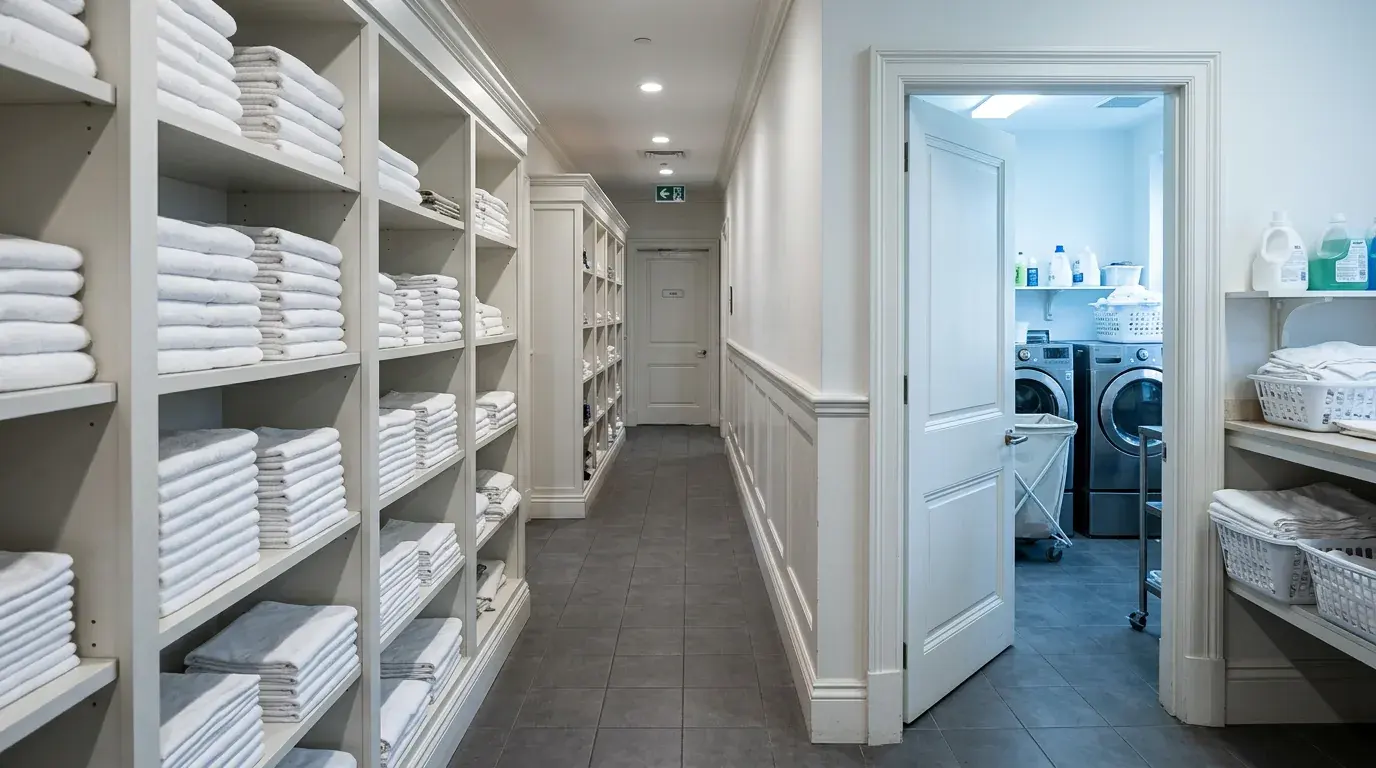
Housekeeping and opening. Properties used seasonally still need to be opened, aired, checked and closed. Empty is not the same as dormant.
Security. Monitoring, response arrangements, and — for anything with a public profile — discretion as an explicit requirement rather than an assumption.
Specialist technical cover. Pool plant, climate systems, lifts, generators, water treatment. These are maintenance contracts, and the good ones are not cheap.
Recruitment agencies publish salary guides for each of these roles, and the ranges differ by a wide margin between countries and between agencies. None of those figures is quoted here: they are marketing for a placement service rather than published labour data, they date quickly, and — as the next section explains — a salary is in any case the smaller half of what a member of staff costs.
Employment is a legal relationship, not a convenience
The line most often missing from a private owner's model is that engaging people creates obligations that have nothing to do with the wage.
Depending on the jurisdiction, an employer may face payroll taxes and social contributions, minimum notice and severance rules, working-time and rest-period rules, holiday entitlement, sick pay, insurance requirements, and record-keeping duties. None of these is optional and none appears in a headline salary figure. In some countries the total cost of employing someone is materially above what they receive.
Two features specific to private households complicate it further.
Accommodation and benefits in kind. Where staff live on the property, the accommodation may itself be treated as taxable remuneration, and there may be separate housing standards to meet. This is jurisdiction-specific, it changes, and it is the sort of thing that is quietly wrong for years until it is expensively right.
The blurred boundary. Household employment frequently lacks the documentation that ordinary employment has — no written contract, no recorded hours, informal arrangements inherited from a previous owner. That informality is entirely the employer's risk, and it surfaces at exactly the moment a relationship ends badly.
The practical consequence is simple: take local employment advice before the first person starts, not after the first dispute. On a cross-border purchase this is one of the few genuinely urgent items, because the obligations attach from the first day of work rather than from the day you get round to the paperwork.
In-house, contracted, or a managing agent
The same functions can be delivered by employees, by an agency, or by a managing agent, and the right answer depends on utilisation rather than on preference.
| Model | What it buys | What it costs | Where it fits |
|---|---|---|---|
| Direct employment | Continuity, discretion, knowledge of the property | Highest fixed cost, all statutory obligations | High occupancy, permanent household |
| Contractors and specialists | Certification, their own insurance and compliance | Variable, higher per hour | Plant, grounds, seasonal and certified work |
| Managing agent | One accountable party who engages the rest | A fee on top, less direct control | Seasonal or remotely held property |
Direct employment buys continuity and discretion and costs the most in fixed terms. Contractors convert a fixed cost into a variable one and bring their own insurance and compliance, which makes them the obvious answer for plant maintenance, seasonal grounds work and anything requiring certification. A managing agent sits between the two: a single accountable party at a fee.
On a property used seasonally or held remotely, the agent is frequently the honest answer, because the alternative is that the owner becomes the managing agent themselves without noticing. The question that settles it: how many days a year does this function actually need someone present? Below a threshold, employing is buying idle capacity.
The systems that must not fail
The distinguishing feature of high-end property is the amount of continuously running plant, and the important point is that it runs whether anyone is in residence or not.
Every large property has a small number of systems whose failure is not an inconvenience but an event. Identify them explicitly, because they determine what cover you need rather than what cover feels reasonable.
- Heating, where failure in winter risks burst pipes and damage to fabric and contents
- Water supply and treatment, particularly on private wells or where the system cannot be left stagnant
- Power, where the grid is unreliable and backup generation must be tested rather than assumed
- Climate control protecting artwork, wine, instruments or historic fabric
- Drainage and pumps on properties below their surroundings or near water
- Security and monitoring, including what happens when the connection itself fails
- Access, where a single private road, bridge or lift isolates the property when it is out
For each one the questions are the same: who is called, how quickly can they attend, and what is the interim arrangement while they are on their way.
Cover, rotas and the holiday problem
A staffed property needs the function covered, not the person employed. Those are different things and the gap between them is where amateur arrangements fail.
One person covering a critical function means the property is uncovered whenever they are ill, on holiday, or leaving. On a property where a heating failure in February is a serious event, single-person cover is not a staffing model, it is a hope.
The realistic answers are a second trained person, a retained local contractor with keys and instructions, or a managing agent with an out-of-hours arrangement. All three cost money. The alternative also costs money, just less predictably and usually at the worst moment.
The seasonal-use trap, in arithmetic
Every figure here is invented. They are not real wages, contract prices or benchmarks. They exist to show why utilisation dominates.
Suppose a property with 180,000 of genuinely fixed annual cost — the roles and contracts that exist regardless of occupancy — and 40,000 of variable cost that only arises when the property is in use.
Used 300 nights a year, the cost per night is roughly 733.
Used 40 nights a year, the fixed cost barely moves. Total is about 185,000 for 40 nights, or about 4,600 per night.
Same property, same staff, same systems. The only variable is use, and it changes the cost per night by a factor of six. This is why a rarely used second home is frequently the worst-value property anyone owns, and it is the same arithmetic our private aviation guide runs on flight hours and our superyacht guide runs on weeks aboard.
Run it on your own figures before buying. If the resulting cost per night is a multiple of what an excellent hotel or a seasonal rental would charge, that is not an argument against buying — but it does mean you are buying control, continuity and availability rather than value, and it is better to know which.
The counter-argument
Everything above treats staff as a cost line, and an owner would rightly say that is not what a household is. A team that has run a property for a decade knows which window sticks, which contractor actually turns up, and how the family likes the house before they arrive. That institutional memory is not replaceable by a managing agent's rota, and it is a large part of why an old estate runs smoothly and a newly acquired one does not.
There is also a duty in it. These are people whose livelihoods and often whose homes are attached to the property, and an owner who treats the payroll as a variable to optimise each season will find that the good ones leave first. The right conclusion is not to minimise the staffing but to size it honestly at purchase, so that it is funded properly and stably rather than cut in the first bad year.
What to ask before you commit
- Which roles exist today, on what contracts, and would they transfer?
- What is the total employment cost, including contributions and statutory entitlements, not the wage?
- Is any accommodation provided, and how is that treated for tax and for housing standards?
- Which functions are covered by a single person, and what is the arrangement when they are away?
- Which maintenance contracts are in place, what do they cover, and when do they renew?
- What are the response times for heating, water, power and security failures?
- What does it cost to close the property properly for a season, and to reopen it?
- Has anything been running on informal arrangements with no written contract?
- What would a managing agent charge to take the whole thing on, as a comparison?
General information, not legal, employment or tax advice. Employment obligations, benefit-in-kind treatment and housing standards differ by country and change; no wage, rate or threshold is stated here because none could be verified at a dated primary source across jurisdictions, and published agency salary guides are marketing rather than labour statistics. The worked example uses invented figures to show a mechanism. Take local advice before engaging anyone.
Next in this series: what carrying cost does to your return.
Frequently asked questions
What staffing and operational roles appear on a trophy property whether planned or not?
Essential roles include estate or property management to hold keys and meet contractors, continuous groundskeeping for mature planting, housekeeping and seasonal opening, security with discretion, and specialist technical cover for systems like pool plants, climate control, lifts, generators, and water treatment.
How do direct employment, contractors, and managing agents differ for property upkeep?
Direct employment buys continuity and discretion at the highest fixed cost. Contractors convert fixed costs into variable ones while bringing compliance for plant and grounds. A managing agent provides a single accountable party for a fee, which suits seasonal or remotely held properties.
Which critical property systems must run continuously regardless of whether anyone is in residence?
Critical running systems include heating to prevent burst pipes, water supply and treatment, power via tested backup generators, climate control for delicate items, drainage and pumps, and security monitoring systems that must remain functional at all times.
How does utilisation affect the cost per night of owning a trophy property?
Fixed annual operational costs remain largely unchanged regardless of occupancy. Consequently, reducing the number of nights used per year dramatically multiplies the cost per night, making infrequently visited second homes significantly more expensive on a per-night basis.