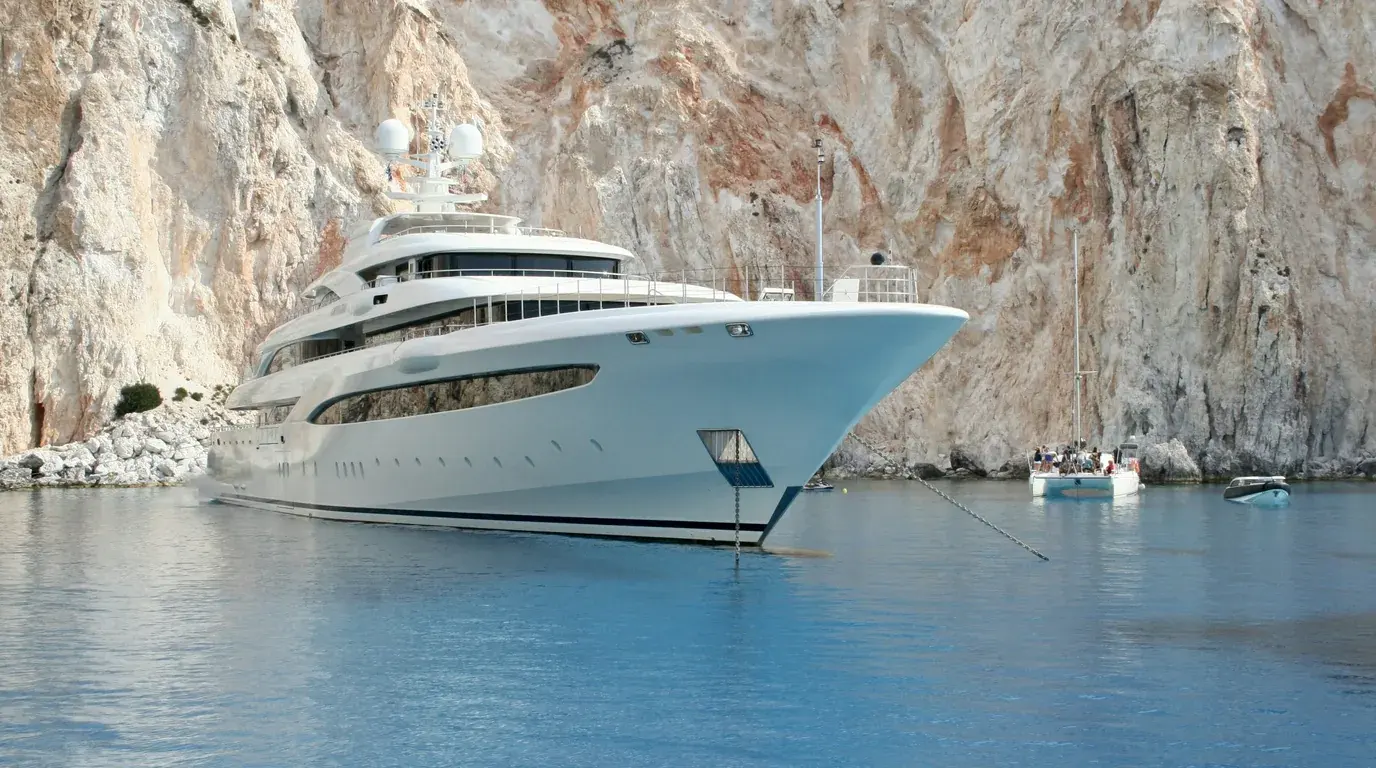
Ask what a superyacht costs and you will usually be told the asking price. Ask what it costs to own and the answer is harder to pin down, because the annual figure is the one that decides whether the purchase was sensible, and unlike the price it is not negotiable and it never stops.
This guide is about the recurring number rather than the headline one.
The rule of thumb, and what it is actually worth
The industry has a widely repeated shorthand that expresses annual running cost as a fixed percentage of purchase price. It is worth being precise about the status of that shorthand, because it is often repeated as though it were published data, and we deliberately do not quote a number for it here.
We have found no regulator, class society or flag state that publishes such a figure. It is a rule of thumb that circulates because it is memorable rather than because it is measured, and it cannot reflect the things that actually drive the bill: age, size, itinerary, crew policy, refit cycle and how much the yacht is used. At most it is a rough sanity check on a proposal, never a budget.
The honest version is that the annual cost is a material percentage of value, it varies enormously with size, itinerary, standards and crew policy, and the only figure worth planning against is a line-by-line budget built for the specific vessel by someone with no commission in the transaction.
What the annual budget is actually made of
| Cost line | What drives it | Why it varies so widely |
|---|---|---|
| Crew | Headcount, certification, rotation policy | Rotation means employing more than one person for some positions; it is a standards choice |
| Maintenance and refit | Age, build quality, hours run, class cycle | Periodic refits are lumpy and dominate the year they fall in |
| Fuel | Cruising speed, hull form, miles run | Speed costs disproportionately; itinerary is the lever |
| Insurance | Value, cruising area, claims history, crew record | Cruising-area warranties change the premium materially |
| Berthing | Marina, season, length, beam | Peak-season prime berths are a market of their own |
| Flag, class and compliance | Registry, survey cycle, commercial or private use | Commercial operation raises the compliance burden |
| Shore management | Whether you retain a management company | Buys expertise, adds a fee, can save more than it costs |
| Provisioning and guest costs | Weeks aboard, standards, guest numbers | The only genuinely variable line on the list |
Crew is often one of the largest items, and it is easy to underestimate because owners tend to think in salaries. A crew is a payroll with recruitment, training, certification, travel, accommodation, insurance and rotation attached, and the total employment cost sits well above the wage bill.
Note what the table shows about the shape of the problem: almost every line is fixed against use. A yacht that sits at anchor for eleven months still carries crew, insurance, berthing, class and maintenance. Only fuel and provisioning fall away.
The seasonal-use trap, in arithmetic
The figures below are invented and exist only to expose the mechanism. No real vessel, wage or contract is described.
Suppose a yacht with 1,000 of genuinely fixed annual cost — crew, insurance, berthing, compliance, planned maintenance, shore management — and 200 of variable cost that arises only when she is used.
Used twelve weeks a year, total cost is 1,200 for 84 nights aboard, or roughly 14 per night.
Used four weeks a year, the fixed cost does not move. Total is about 1,067 for 28 nights, or roughly 38 per night.
Same yacht, same crew, same berth. The only variable is use, and it changes the cost per night by nearly a factor of three. This is exactly the arithmetic our carrying cost guide runs on a trophy house, and it produces the same uncomfortable comparison: against chartering an equivalent vessel for the weeks you actually want her.
That comparison is the one most first-time buyers avoid, and it is the one that matters most.
Charter income, stated honestly
Commercial charter is routinely presented as the way a yacht pays for itself. It reduces the net cost. It does not eliminate it, and the trade is more involved than a brochure suggests.
Charter income arrives gross and leaves considerably lighter after central-agency and retail brokerage commission, crew gratuities, the additional wear that guest weeks impose, and the higher standard of presentation and refit a charter-market boat must maintain to hold its rate. Providers quote the proportion of running costs that charter typically offsets; those figures come from the companies who arrange charters, they assume a level of occupancy that is not guaranteed, and none of them is a forecast for your vessel.
There are structural costs too. Operating commercially means complying with the safety and manning regime that applies to your flag, tonnage and use — which affects crew certification, manning levels and survey frequency, and is a question for your flag state and class society rather than a rule of thumb. It constrains your own use, because the best weeks to charter are the best weeks to be aboard. And the VAT and importation treatment of a commercially operated yacht in European waters turns on flag, ownership structure, itinerary and the current position of the relevant tax authorities.
Take advice specific to your intended cruising ground rather than applying a rule borrowed from a different one. The related shore-side question of where tax actually attaches is covered in our tax residency guide.
New build: the contract is the boat
For a new build, the document that determines your experience is not the general arrangement drawing but the contract behind it. Custom construction runs for years against a specification that will change, and the contract decides who pays for those changes and what happens when the yard's schedule slips.
- Stage payments tied to verified construction milestones rather than calendar dates
- Refund guarantees from a bank of substance, covering instalments already paid
- Title passing progressively during construction, so the hull is yours if the yard fails
- A written variation-order procedure, with pricing agreed before work proceeds
- Liquidated damages for late delivery, and the cap that applies to them
- Performance guarantees on speed, range and noise, with sea-trial conditions defined
- Warranty scope and duration after handover, including who funds rectification travel
Owner's representatives and independent build-supervision teams exist because this is genuinely difficult, and their fee should be weighed against the sums at risk rather than against zero.
On the pre-owned side the equivalent discipline is the survey: an in-water and out-of-water condition survey, an engine-hours and maintenance-history review, a class and flag compliance check, and a look at how the previous owner used her. A lightly used yacht is not automatically a good one; machinery dislikes sitting idle, and a well-maintained boat that has worked can be in better order than a neglected one that has not.
Flag, and why it is a real decision
Every yacht is registered under the flag of a sovereign state, and the choice affects regulatory requirements, survey burden, crew certification, tax treatment and whether commercial charter is permitted at all. Several registries have built substantial superyacht practices and compete on service and clarity.
What matters is that this is a decision to take with a specialist at the outset rather than to inherit from whoever sold you the boat. A flag that suits a privately used vessel in one cruising ground may be the wrong answer for a commercially operated one in another, and changing flag later is possible but not free.
The question worth asking before any of this
Before the yard, the length or the flag, the useful question is how many weeks a year you will genuinely be aboard — based on your actual diary over recent years, not on intention.
If the honest answer is a handful of weeks, it is worth considering whether chartering a different, larger and newer boat each season would deliver more of what you actually want — variety of cruising ground, no crew management, no refit exposure, no resale risk — for a much smaller commitment. That is not a failure of ambition. It is the same discipline that stops a property investor buying a house in every city they happen to like, and it is the discipline our returns guide argues for throughout. The same test applies to the other large possession collectors buy for pleasure and are told will appreciate: classic cars, where the indices report prices but not what ownership costs.
The counter-argument, and it is a good one
Everything above frames ownership as a cost problem, and that framing misses what owners actually buy. A yacht with your own crew is a floating private estate: the stewardess knows how your children take breakfast, the chef knows the allergy, the boat is provisioned the way you like before you land. A chartered vessel, however excellent, is a hotel you have to re-explain yourself to every season.
For a family that gathers across generations, in genuine privacy, in places a hotel cannot reach, that continuity is the entire point and no cost-per-night calculation captures it. The fair conclusion is not that ownership is irrational — it is that ownership should be bought with open eyes as consumption rather than sold as an investment, and that the annual number should be modelled honestly before rather than discovered afterwards.
What to establish before you commit
- How many weeks a year will I realistically be aboard, based on the last three years?
- What does a line-by-line annual budget for this specific vessel look like, prepared by someone with no commission in the sale?
- What is the crew policy — rotation or not — and what is the total employment cost rather than the wage bill?
- When does the next class survey and the next major refit fall, and what is provisioned for them?
- What flag is proposed, why, and does it permit the use I intend?
- If I intend to charter, what does my flag and tonnage require, and who has confirmed it?
- What is the VAT and importation position for my intended cruising ground and structure?
- On a pre-owned purchase, what do the condition survey and maintenance history actually show?
- What would chartering an equivalent vessel for my realistic weeks cost instead?
Own the lifestyle, not the illusion of a return. A superyacht is typically a depreciating asset with substantial fixed annual costs; charter income can offset but not erase them, and resale values are not guaranteed. Bought as a floating private estate rather than an investment, it delivers something no balance sheet captures.
General information, not financial, tax or legal advice. No figure in this article is a quote, a benchmark or a forecast, and every number in the worked example is invented. Flag, VAT, crewing and charter rules differ by registry and cruising ground; take specialist advice for the specific vessel before committing.