How a purchase works
Most French sales begin with a preliminary contract, in one of two forms: a promesse unilatérale de vente, in which the seller commits and the buyer pays an immobilisation deposit (usually 5% to 10%), or a compromis de vente, which binds both sides and typically carries a deposit of around 10%. A buyer of a home then has a cooling-off period of ten calendar days, running from the day after the contract is notified. A promesse lasting more than 18 months must be drawn up as an authentic act, with a minimum deposit of 5% (Service-Public.fr, Promesse de vente).
The preliminary contract can include conditions — obtaining a loan, the local authority waiving its right of pre-emption — and the sale is completed by an authentic deed signed before a notary (Notaires de France, The sales agreement). The notaries' guidance for non-resident buyers names no special authorisation; it notes that French law governs the sale and that the notary checks the origin of funds to prevent money laundering (Notaires de France, Purchase in France by non-residents). Have the source-of-funds file ready before you sign the preliminary contract, not after.
What it costs to buy
What buyers call "notary's fees" are mostly taxes. On an existing home, Notaires de France gives total transfer duties of 6.31% plus a 0.10% land-registry contribution; on a new home bought from a professional seller, 20% VAT is included in the price and duties fall to 0.71% plus 0.10%. The notary's own remuneration follows a regulated state tariff by price band, and the notaries point out that up to four-fifths of what the buyer hands over goes to the state (Notaires de France, Frais d'acte de vente).
The departmental share of those duties was between 3.8% and 4.5%, and from 1 April 2025 departments were allowed to raise it by up to 0.5 point until 30 April 2028 — though not for first-time buyers of a main home (Service-Public.fr, April 2025). Ask the notary for the rate in force in the Alpes-Maritimes or the Var on your completion date.
What it costs to hold
Every owner pays taxe foncière. A second home also still pays taxe d'habitation, and communes in tight housing markets may add a surcharge of 5% to 60% on it (Service-Public.fr, Taxe d'habitation on second homes); whether a given Riviera commune applies one is a question for its town hall.
The impôt sur la fortune immobilière (IFI) is due when net real-estate wealth exceeds €1,300,000. The scale runs 0.50% on the band from €800,001 to €1.3m, 0.70% to €2.57m, 1% to €5m, 1.25% to €10m and 1.50% above €10m (Service-Public.fr, IFI calculation). Non-residents are liable on the property and property rights they hold in France (Service-Public.fr, IFI: who and what).
Selling, and tax on the gain
For a non-resident seller, impots.gouv.fr describes income tax on the gain at 19%, full relief from income tax after 22 years of ownership and from social charges after 30, social charges of 17.2% — or, for sellers covered by EEA or Swiss social security, the 7.5% solidarity levy instead — and the notary collecting the tax at completion (impots.gouv.fr, non-resident property gains). One of the pages we read is dated 2022, so confirm the current rates with the notary before you rely on them.
Residency
We have found no French route that grants residence for buying property. A non-EU buyer who wants to live on the Riviera needs a visa and residence basis of their own, separate from the purchase.
Try the coast before you buy it
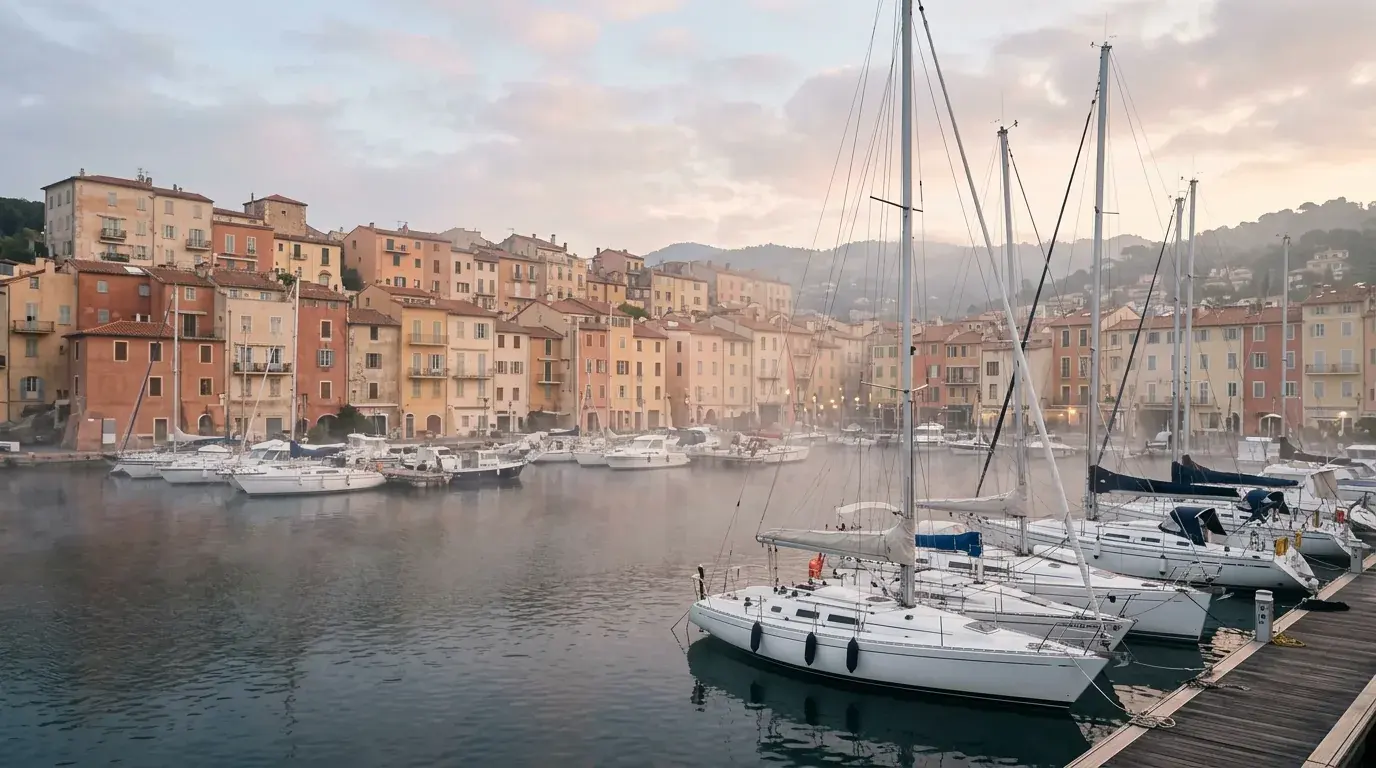
The Riviera is not one place: a village in the hills behind Nice, a cape near Antibes and the Golfe de Saint-Tropez live very differently out of season. Renting in the exact area for a few weeks — ideally in winter — is the cheapest due diligence there is.